This is a slightly technical blog post about printing colour books in Australia, but it’s an issue I’ve come up against several times with my clients.
I help many individuals with memoirs, autobiographies, and nonfiction books. These books nearly always include colour images, whether photos or graphics. We spend a lot of time ensuring the images are at their best by using the optimum resolution (300 dpi is best), cropping, enhancing, and arranging them on the page.
Beautiful!
These images are best displayed on white 70 lb paper, as 50 lb paper tends to be a little see-through. Besides, these books are often family keepsakes or business books and need a good-quality finish.
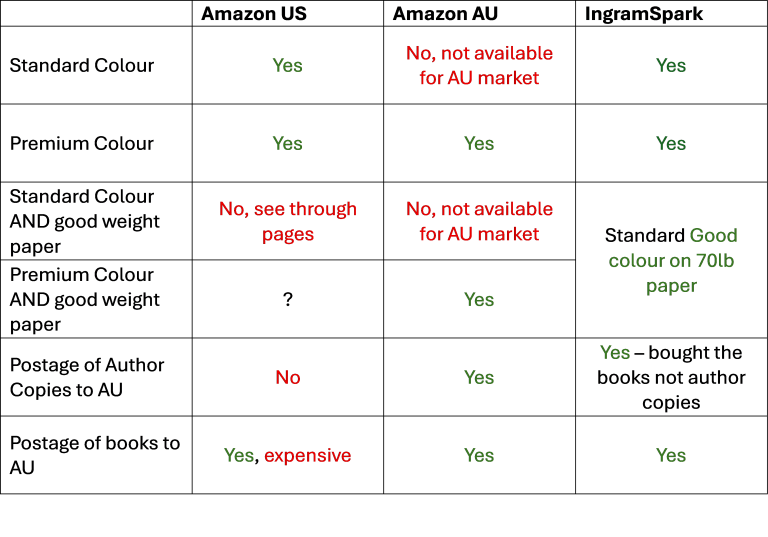
Then we get to the upload stage on KDP and—lo and behold—Amazon Australia does not accept standard colour books. The reason given is that they do not have access to printing facilities in Australia, although I’ll explain shortly why this is a rather weak excuse.
This poses a big dilemma. I was lucky to have a curious, problem-solving client who was happy to run some experiments with her nonfiction book. Her book is about a system called Click! Colours, so, as you can imagine from the title alone, the use of colour was paramount. There was no way this book could be printed in black and white, which immediately ruled out the simplest solution.
However, she—and her business, which runs courses and team-building workshops in Australia—needed to publish in the Australian marketplace.
When you upload a book on the KDP platform, you choose a marketplace at the beginning (for example, Australia: amazon.com.au; USA: amazon.com; UK: amazon.co.uk). This determines where the book is printed.
Christine and I ran an experiment to see if we could find a way around the issue.
First, we chose to print in the American marketplace. We successfully uploaded the book using standard colour. However, when it came time to order the author copy, Amazon would not ship it to Australia. Luckily, Christine had a family member in the US who was travelling to Australia a few weeks later, so we had the author copy sent to him instead.
You can get around this by buying your own book directly from Amazon if you decide to publish before checking the proof. However, if the book is printed in America, postage costs will be higher and wait times longer. If you’re keen to publish ASAP, this can significantly affect your timeline.
Although the issue suggests that the difference between standard and premium colour printing is about ink quality or volume, it actually comes down to paper weight. Both options are listed as 90 gsm, but standard colour paperbacks are printed on lighter paper (55 lb), while premium colour paperbacks use heavier paper (60 lb), which enhances image quality and clarity.
Paper weight refers to the heaviness of a sheet of paper, which influences its feel, durability, and printing quality. It is often measured in pounds (lb, also denoted by #) in the US and in grams per square metre (g/m²) in the metric system. GSM measures the weight of a one-square-metre sheet, providing a universal way to compare paper types.
This leads to another issue: spine width. Lighter 50 lb paper takes up less space, meaning you’ll also need a differently sized book cover. This shouldn’t be a problem for your cover designer, but it’s best to make this decision before uploading so you’re prepared.
You’ll also need to ask your designer for two covers for different platforms anyway, as IngramSpark uses slightly different paper weights (50 lb or 70 lb).
Next, we assigned a new ISBN to another edition and uploaded it to the Australian marketplace using premium colour (the only colour option available). However, the print cost was almost twice that of the US version using standard colour.
Of course, there is always IngramSpark, which distributes to Amazon and doesn’t have the same colour-printing limitations. The ironic part is that Amazon sometimes uses IngramSpark’s printing facility, Lightning Source, to print books here in Australia.
IngramSpark is a great option for people who simply want their book printed and are not pursuing the project as a commercial venture. However, for Christine, this book supports her business, and she would love to make some money from sales. When you distribute through IngramSpark, they take a cut, and your compensation is lower than your royalty when selling directly through KDP.
IngramSpark does not pay a royalty in the same way Amazon does. Instead, they take around 15% of the list price after the wholesale discount has been applied.
For example, if your book is listed at $20.00 with a 50% wholesale discount:
$20 – 50% discount = $10
$10 – $5 print cost = $5.00
$5.00 × 15% = $0.75
Publisher compensation: $4.25
On KDP, royalties are calculated as:
(Royalty rate × list price) – printing costs
So for a print book:
60% × $20 = $12
$12 – $5 = $7.00
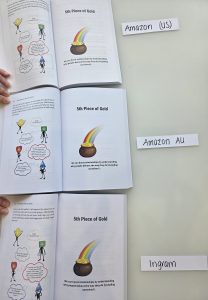
 Christine also published through IngramSpark, and the beauty of this experiment is that we now have three physical books to compare.
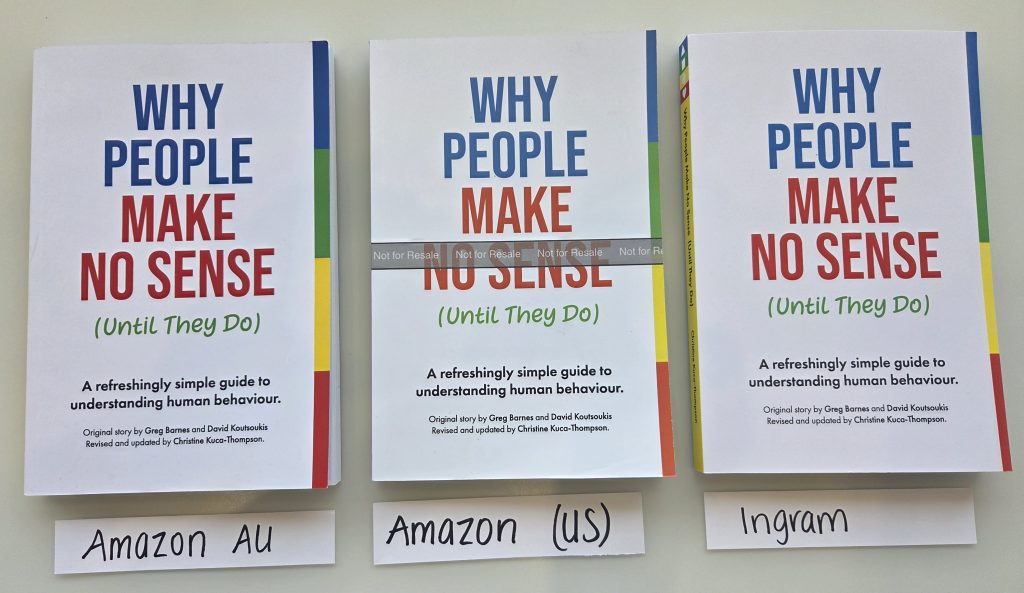
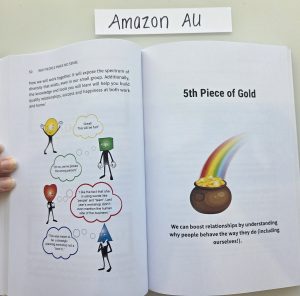
The Amazon Australia copy is by far the best quality, largely because it uses premium colour printing and costs almost twice as much to produce.
The IngramSpark copy is also excellent, thanks to its heavier 70 lb paper compared to KDP’s 60 lb.
The Amazon US copy suffers slightly from paper transparency, which detracts from the overall finish.
All is not lost with Christine’s American marketplace edition, however. We’ll be adjusting the language to US spelling and conventions so the book will be ready when they eventually expand into the American market.
By the way, this post wasn’t meant to plug Christine TeamLINQ or Click! Colours but if you have a team and you’re looking for a way to build relationships and improve communication, it really is a fantastic program. It’s great fun, and not only do you improve working relationships, you also gain insight into why people behave the way they do—and with understanding comes acceptance.
I hope this post helps you make an informed decision when printing colour books in Australia as a self-publisher. Hopefully, Amazon will soon recognise that there are capable printing facilities on this side of the world, and we’ll be able to sell beautiful books at a decent price and with a decent profit.
If you need help with self-publishing or want to chat more about printing colour books through Amazon Australia and other platforms, please get in touch.